Inspect binary representation
Count 1’s in binary representation for each index.
For a number 
count_ones take 


Time: 

class Solution:
    def countBits(self, n: int) -> List[int]:
        def count_ones(x: int) -> int:
            one_count = 0
            while x > 0:
                q, r = divmod(x, 2)
                one_count += (1 if r == 1 else 0)
                x = q
            return one_count

        ans = [0] * (n+1)
        for x in range(n+1):
            ans[x] = count_ones(x)
        return ans
Dynamic programming
On every power-of-two, an extra one-bit is added and the count-of-ones pattern restarts, as if we are counting from 0 again.
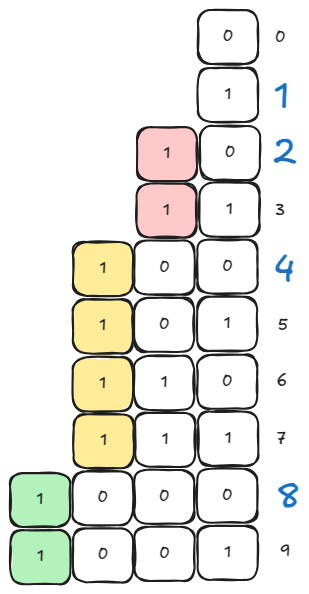
As a result, to compute count of ones in 
Sub-problem
Let 


Order
A sub-problem depends on exactly one sub-problem involving a smaller number. So, we compute count of ones in increasing order of
Time: 
class Solution:
    def countBits(self, n: int) -> List[int]:
        ans = [0] * (n+1)
        curr_pow, next_pow = None, 1
        for i in range(1, n+1):
            if i == next_pow:
                curr_pow = next_pow
                next_pow <<= 1
            ans[i] = 1 + ans[ i-curr_pow ]
        return ans
 unreasonably effective
Leave a comment