Brute force
Take max of all possible subarrays.
Products of all possible subarrays starting at a particular index can be computed in 


class Solution:
    def maxProduct(self, nums):
        n = len(nums)
        largest_product = float('-inf')
        for start in range(n):
            current_product = 1
            for end in range(start, n):
                current_product *= nums[end]
                largest_product = max(
                    largest_product,
                    current_product
                )
        return largest_product
Dynamic programming
Subproblem
Without negative numbers
Let 
nums[0:i+1] for a subarray that includes nums[i]. Then, either nums[i] belongs to the subarray of 
nums[i]is the first element of a subarray.
![L(i) = \begin{cases} max\left( \{ L(i-1) \cdot \texttt{nums}[i], \ \texttt{nums}[i] \} \right), & \texttt{if } i > 0 \\ \texttt{nums}[i] & \texttt{otherwise} \end{cases}](https://s0.wp.com/latex.php?latex=L%28i%29+%3D+%5Cbegin%7Bcases%7D+max%5Cleft%28+%5C%7B+L%28i-1%29+%5Ccdot+%5Ctexttt%7Bnums%7D%5Bi%5D%2C+%5C++%5Ctexttt%7Bnums%7D%5Bi%5D+%5C%7D+%5Cright%29%2C+%26+%5Ctexttt%7Bif+%7D+i+%3E+0+%5C%5C+%5Ctexttt%7Bnums%7D%5Bi%5D+%26+%5Ctexttt%7Botherwise%7D+%5Cend%7Bcases%7D&bg=ffffff&fg=000&s=0&c=20201002)
Our solution is then 
nums[i:j+1] has the largest product. When we computed nums[i] must have started a new subarray. And 

nums[i:j+1].
With negative numbers
Product of two negative numbers is positive. That adds another way for nums[i] to be a part of an earlier subarray. Let 
nums[0:i+1] for a subarray that includes nums[i]. Now, we can update
![L(i) = \begin{cases} \max\left( \{ L(i-1) \cdot \texttt{nums}[i], \ S(i-1) \cdot \texttt{nums}[i], \ \texttt{nums}[i] \} \right), & \texttt{if } i > 0 \\ \texttt{nums}[i] & \texttt{otherwise} \end{cases}](https://s0.wp.com/latex.php?latex=L%28i%29+%3D+%5Cbegin%7Bcases%7D+%5Cmax%5Cleft%28+%5C%7B+L%28i-1%29+%5Ccdot+%5Ctexttt%7Bnums%7D%5Bi%5D%2C+%5C+S%28i-1%29+%5Ccdot+%5Ctexttt%7Bnums%7D%5Bi%5D%2C+%5C++%5Ctexttt%7Bnums%7D%5Bi%5D+%5C%7D+%5Cright%29%2C+%26+%5Ctexttt%7Bif+%7D+i+%3E+0+%5C%5C+%5Ctexttt%7Bnums%7D%5Bi%5D+%26+%5Ctexttt%7Botherwise%7D+%5Cend%7Bcases%7D&bg=ffffff&fg=000&s=0&c=20201002)
Symmetrically, for
![S(i) = \begin{cases} \min\left( \{ S(i-1) \cdot \texttt{nums}[i], \ L(i-1) \cdot \texttt{nums}[i], \ \texttt{nums}[i] \} \right), & \texttt{if } i > 0 \\ \texttt{nums}[i] & \texttt{otherwise} \end{cases}](https://s0.wp.com/latex.php?latex=S%28i%29+%3D+%5Cbegin%7Bcases%7D+%5Cmin%5Cleft%28+%5C%7B+S%28i-1%29+%5Ccdot+%5Ctexttt%7Bnums%7D%5Bi%5D%2C+%5C+L%28i-1%29+%5Ccdot+%5Ctexttt%7Bnums%7D%5Bi%5D%2C+%5C++%5Ctexttt%7Bnums%7D%5Bi%5D+%5C%7D+%5Cright%29%2C+%26+%5Ctexttt%7Bif+%7D+i+%3E+0+%5C%5C+%5Ctexttt%7Bnums%7D%5Bi%5D+%26+%5Ctexttt%7Botherwise%7D+%5Cend%7Bcases%7D&bg=ffffff&fg=000&s=0&c=20201002)
Again, we find the solution as
Order
Since edges always go from smaller indices to larger indices, we can process the numbers from left-to-right and have a topological ordering.
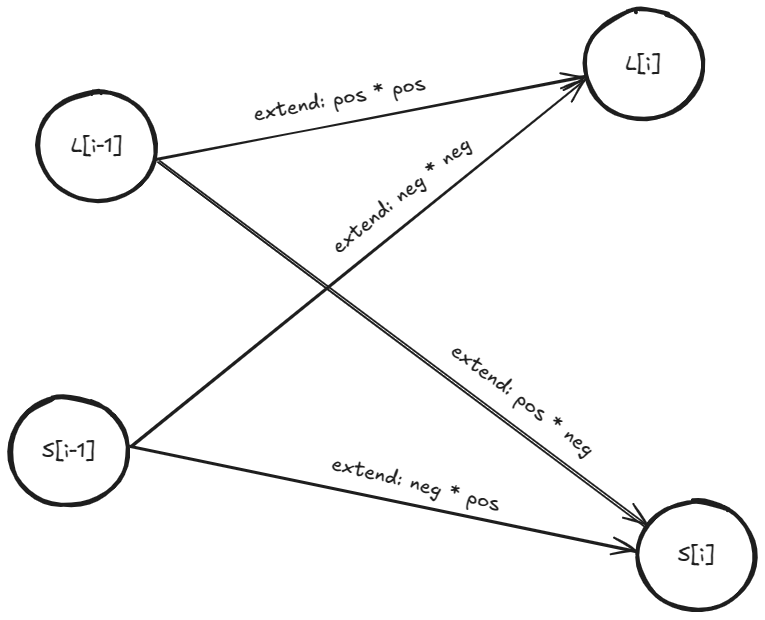
Time:
class Solution:
    def maxProduct(self, nums):
        n = len(nums)
        L, S = [0] * n, [0] * n
        L[0], S[0] = nums[0], nums[0]
        for i in range(1, n):
            L[i] = max(
                L[i-1] * nums[i],
                S[i-1] * nums[i],
                nums[i]
            )
            S[i] = min(
                L[i-1] * nums[i],
                S[i-1] * nums[i],
                nums[i]
            )

        return max(L)
Since edges always go from index i+1 to index i, we can use a single variable instead of n-sized list.
Time:
class Solution:
    def maxProduct(self, nums):
        n = len(nums)
        L, S, global_L = nums[0], nums[0], nums[0]
        for i in range(1, n):
            L, S = max(L * nums[i], S * nums[i], nums[i]), min(
                L * nums[i], S * nums[i], nums[i]
            )
            global_L = max(global_L, L)
        return global_L
 unreasonably effective
Leave a comment