Backtrack
If a prefix s[0:l] is a dictionary word, we then try breaking s[l:].
Time: 

class Solution:
    def wordBreak(self, s: str, wordDict: List[str]) -> List[str]:
        dict_words = set(wordDict)
        curr_words = []
        sentences = []
        def build(s):
            nonlocal dict_words, curr_words, sentences
            if not s:
                sentences.append( " ".join(curr_words) )
                return

            for l in range(1, len(s)+1):
                if (pref := s[0:l]) not in dict_words:
                    continue
                curr_words.append(pref)
                build(s[l:])
                curr_words.pop()

        build(s)
        return sentences
The solutions can be thought of as paths in a DAG.
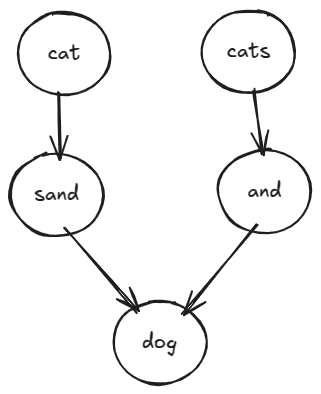
If we can construct the DAG, we can traverse the paths and collect the sentences.
Dynamic Programming
Subproblem
Say the input string is ![x[1 \ldots n]](https://s0.wp.com/latex.php?latex=x%5B1+%5Cldots+n%5D&bg=ffffff&fg=000&s=0&c=20201002)

![x[1 \ldots i]](https://s0.wp.com/latex.php?latex=x%5B1+%5Cldots+i%5D&bg=ffffff&fg=000&s=0&c=20201002)
![W[i] = \begin{cases} \texttt{true}, & \text{if } i = 0 \\ \bigvee\left( \left\{ W(j) \wedge x[j+1 \ldots i] \in \texttt{wordDict} \right\} \right) & \text{otherwise} \end{cases}](https://s0.wp.com/latex.php?latex=W%5Bi%5D+%3D+%5Cbegin%7Bcases%7D+%5Ctexttt%7Btrue%7D%2C+%26+%5Ctext%7Bif+%7D+i+%3D+0+%5C%5C+%5Cbigvee%5Cleft%28+%5Cleft%5C%7B+W%28j%29+%5Cwedge+x%5Bj%2B1+%5Cldots+i%5D+%5Cin+%5Ctexttt%7BwordDict%7D+%5Cright%5C%7D+%5Cright%29+%26+%5Ctext%7Botherwise%7D+%5Cend%7Bcases%7D&bg=ffffff&fg=000&s=0&c=20201002)

We can piggyback on this problem to build the adjacency list of the DAG.
Order
Processing input left-to-right gives a topological ordering of the subproblems.
We have two options for building the adjacency list of the DAG:
- Edge is like
. This means root is the subproblem
.
- Edge is like
. This means root is the subproblem
If there are many false breaks in the beginning, meaning we have been able to break a prefix but did not find further break, option (2) could be better. In option (2) we would traverse only the paths that represent successful break of the entire input.
The code for the two options are almost the same except:
- Edge is reversed in
adj_list - Source and target of
dfsare reversed:(0, n)or(n, 0). - To build the current path, we either
appendorappendleft.
W(0) as root

Complexity
The time complexity depends on the possible number of distinct paths in the DAG. Edges flow from an earlier index (of the string) to a later index. So, in the worst-case, every index may have edges to every other index that come afterwards.
Say 


Note, 


construct_sentence(). As a result, total time complexity is 
Disregarding output size, extra space complexity is the worst-case size of the adj_list, so: 
class Solution:
    def construct_sentence(self, s: str, path: List[int]) -> str:
        words = []
        for i in range(len(path)-1):
            begin, end = path[i], path[i+1]
            words.append( s[begin:end] )
        return " ".join(words)

    def dfs(self, s: str, adj_list: Dict[int, List[int]], u: int, path: deque[int], sentences: List[str]) -> None:
        if u == len(s):
            sentences.append( self.construct_sentence(s, list(path)+[u]) )
            return

        path.append(u)
        for v in adj_list[u]:
            self.dfs(s, adj_list, v, path, sentences)
        path.pop()

    def wordBreak(self, s: str, wordDict: List[str]) -> List[str]:
        word_set = set(wordDict)
        n = len(s)
        adj_list = defaultdict(list)
        dp = [True] + [False]*n
        for i in range(1, n+1):
            for j in range(i, 0, -1):
                if not dp[j-1]:
                    continue
                if s[j-1:i] not in word_set:
                    continue
                dp[i] = True
                adj_list[j-1].append(i)
        if not dp[n]:
            return []

        sentences = []
        self.dfs(s, adj_list, 0, deque(), sentences)
        return sentences
W(n) as root

class Solution:
    def construct_sentence(self, s: str, path: List[int]) -> str:
        words = []
        for i in range(len(path)-1):
            begin, end = path[i], path[i+1]
            words.append( s[begin:end] )
        return " ".join(words)

    def dfs(self, s: str, adj_list: Dict[int, List[int]], u: int, path: deque[int], sentences: List[str]) -> None:
        if u == 0:
            sentences.append( self.construct_sentence(s, [u]+list(path)) )
            return

        path.appendleft(u)
        for v in adj_list[u]:
            self.dfs(s, adj_list, v, path, sentences)
        path.popleft()

    def wordBreak(self, s: str, wordDict: List[str]) -> List[str]:
        word_set = set(wordDict)
        n = len(s)
        adj_list = defaultdict(list)
        dp = [True] + [False]*n
        for i in range(1, n+1):
            for j in range(i, 0, -1):
                if not dp[j-1]:
                    continue
                if s[j-1:i] not in word_set:
                    continue
                dp[i] = True
                adj_list[i].append(j-1)
        if not dp[n]:
            return []

        sentences = []
        self.dfs(s, adj_list, n, deque(), sentences)
        return sentences
 unreasonably effective
Leave a comment