Decodings can be thought of as paths in a binary tree. So, we need to count the number of paths.
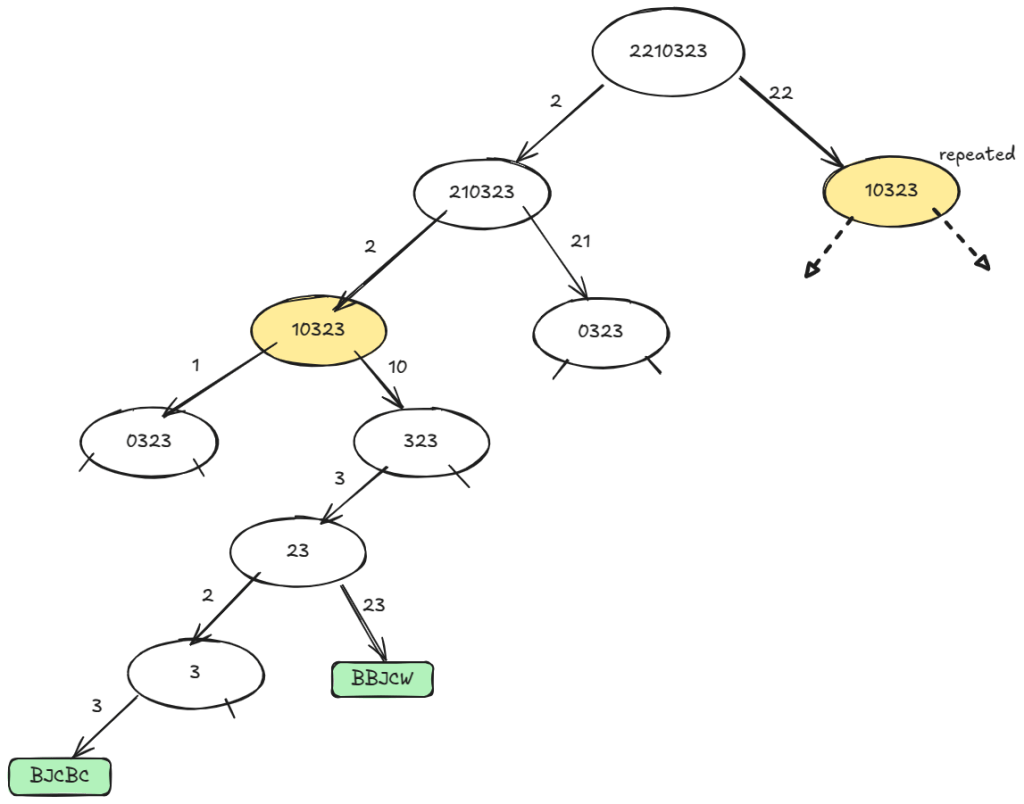
Note, we do not need to keep track of already counted decodings. In the example above, the first decision at the root produced two branches: (1) starts with “2” having symbol “B” (2) starts with “22” having symbol “V”. So, at least this first symbol will be different between a path on the left half and a path on the right half. This reasoning applies recursively to subtrees in either half as well.
Dynamic programming
Subproblem
Let 


str has been decoded successfully, so 
Order
Since edges flow from later to earlier indices, we process the input str right-to-left.
Top-down with memoization
There are only 
If we did not use memoization, in the worst-case, the recursion tree could have depth 
class Solution:
    def dfs(self, s: str, begin: int, memo: Dict[int, int]) -> int:
        if begin in memo:
            return memo[begin]
        if begin == len(s):
            return 1
        if s[begin] == '0':
            memo[begin] = 0
            return memo[begin]
        if begin == len(s)-1:
            return 1

        # Consume one digit
        count = self.dfs(s, begin+1, memo)
        if int( s[begin:begin+2] ) > 26:
            memo[begin] = count
            return memo[begin]
        # Consume two digits
        count += self.dfs(s, begin+2, memo)
        memo[begin] = count
        return memo[begin]

    def numDecodings(self, s: str) -> int:
        return self.dfs(s, 0, dict())
Bottom-up
Time:
class Solution:
    def numDecodings(self, s: str) -> int:
        n = len(s)
        dp = [0] * (n+1)
        dp[n] = 1
        dp[n-1] = 0 if s[n-1] == '0' else 1
        for i in range(n-2, -1, -1):
            if s[i] == '0':
                continue
            dp[i] = dp[i+1]
            if int( s[i:i+2] ) <= 26:
                dp[i] += dp[i+2]
        return dp[0]
A subproblem depends on just two immediately succeeding subproblems, so we can use two variables instead of 
dp.
Time: 
class Solution:
    def numDecodings(self, s: str) -> int:
        n = len(s)
        dp = [0] * 2
        second = 0 if s[n-1] == '0' else 1
        first = 1
        for i in range(n-2, -1, -1):
            first, second = second, first
            if s[i] == '0':
                second = 0
                continue
            second = first if int( s[i:i+2] ) > 26 else first+second
        return second
 unreasonably effective
Leave a comment