Math
Difference between expected sum 
Time: 

class Solution:
    def missingNumber(self, nums: List[int]) -> int:
        n = len(nums)
        expected_sum = (n * (n+1)) // 2
        return expected_sum - sum(nums)
Cyclic sort
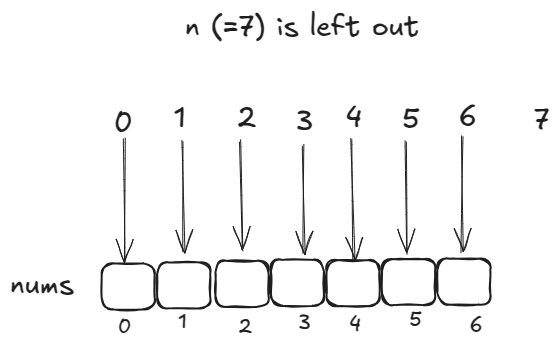
If we think about how nums would look like once sorted, there are two options:
is left out. Then,
for
.
. Then,
and
.
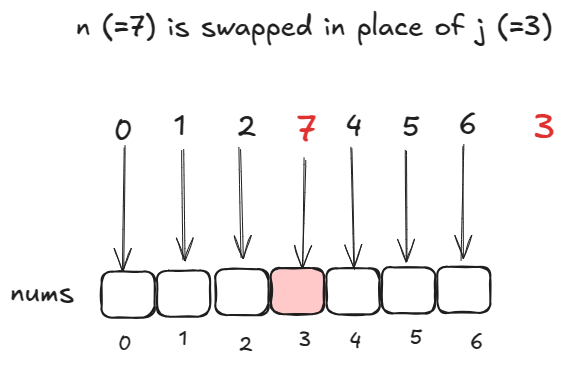
So, if we put each nums[i] in its expected index, there will be zero (first option) or one (second option) index not matching its value.
Time:
class Solution:
    def cyclic_sort(self, nums: List[int], begin: int, end: int, offset: int) -> None:
        for i in range(begin, end):
            while (
                nums[i] != i - begin + offset
                and (j := begin + nums[i] - offset) < end
                and nums[i] != nums[j]
            ):
                nums[i], nums[j] = nums[j], nums[i]

    def find_first_mismatch(self, nums: List[int], begin: int, end: int, offset: int) -> Tuple[int, int]:
        for i in range(begin, end):
            if ( expected := i-begin+offset ) != nums[i]:
                return expected, nums[i]
        return end-begin+offset, None

    def missingNumber(self, nums: List[int]) -> int:
        begin, end, offset = 0, len(nums), 0
        self.cyclic_sort(nums, 0, len(nums), 0)
        missing, _ = self.find_first_mismatch(nums, begin, end, offset)
        return missing
 unreasonably effective
Leave a comment