We want to build a directed graph where vertex set is the alien alphabet and an edge 


Single word
Say words = ["confide"]. With a single word we do not know anything about the ordering between the letters. We can emit the unique letters in the word in any order. As a consequence, we can always add distinct letters from the alien words to the graph as vertices, even if no edges flow to or from them.
Two words
Say words = ["confide", "conflate"]. From the first mismatch ("i" vs. "l"), we would know the edge: 

So, the two words may have three regions: (1) common prefix (2) mismatch (3) suffix. If (2) is present we can infer one edge of the graph. Otherwise, the order is valid except when next word is a proper prefix. Because, if a word is a proper prefix of another, in lexicographic order, the shorter one must come first.
Since it is always a mismatch that contributes an edge, the graph will not have self loop.
Three words
Comparison between (1st and 2nd) or between (2nd and 3rd) words is like comparing two-word input. However, no new information is gained from comparing (1st and 3rd) words. Later (fourth and onwards) words — if compared against 1st — do not give new information either. As a result, we shall compare pairs of consecutive words while building the graph.
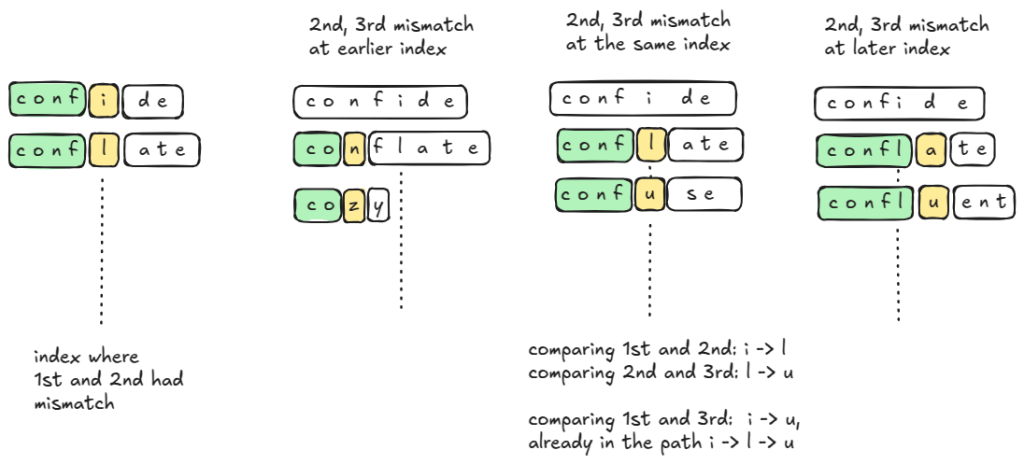
We note that 


class Solution:
    # O(m): m is length of longest word
    def find_edge(self, curr_word, next_word) -> Tuple[str, str]:
        n = min(len(curr_word), len(next_word))
        i = 0
        while i < n:
            if (u := curr_word[i]) != (v := next_word[i]):
                return u, v
            i += 1
        if len(curr_word) <= len(next_word):
            return ("", "")
        return None

    def add_vertices(self, word, adj_list) -> None:
        for c in word:
            if c not in adj_list:
                adj_list[c] = set()

    # O(n * m): n words, m is longest word len
    def build_graph(self, words) -> Dict[str, Set[str]]:
        adj_list = {}
        for i, curr_word in enumerate(words):
            self.add_vertices( curr_word, adj_list )
            # no next word
            if i == len(words)-1:
                break
            next_word = words[i+1]
            edge = self.find_edge( curr_word, next_word )
            # invalid: next_word is a proper prefix of curr_word
            if not edge:
                return None
            u, v = edge
            if u and v:
                adj_list[u].add(v)
        return adj_list

    def is_back_edge(self, u, v, visited, onstack) -> bool:
        return (v in visited) and (v in onstack)

    def explore_cycle(self, u, adj_list, visited, onstack) -> bool:
        visited.add(u)
        onstack.add(u)

        for v in adj_list[u]:
            if self.is_back_edge(u, v, visited, onstack):
                return True
            if v in visited:
                continue
            if self.explore_cycle(v, adj_list, visited, onstack):
                return True

        onstack.remove(u)
        return False

    def has_cycle(self, adj_list) -> bool:
        visited, onstack = set(), set()
        for u in adj_list:
            if u in visited:
                continue
            if self.explore_cycle(u, adj_list, visited, onstack):
                return True
        return False


    def explore_post(self, u, adj_list, visited, post_inc):
        visited.add(u)

        for v in adj_list[u]:
            if v in visited:
                continue
            self.explore_post(v, adj_list, visited, post_inc)

        post_inc.append(u)

    def sorted_topo(self, adj_list) -> List[str]:
        visited = set()
        post_inc = []
        for u in adj_list:
            if u in visited:
                continue
            self.explore_post(u, adj_list, visited, post_inc)
        return post_inc[::-1]

    def alienOrder(self, words: List[str]) -> str:
        # O(n * m)
        adj_list = self.build_graph(words)
        if not adj_list:
            return ""
        # O(1)
        contradict = self.has_cycle(adj_list)
        if contradict:
            return ""
        # O(1)
        lex_sorted = self.sorted_topo(adj_list)
        return "".join( lex_sorted )
Instead of using separate DFS’s to find cycle and topological order, we can do both in a single DFS.
class Solution:
    # O(m): m is length of longest word
    def find_edge(self, curr_word, next_word) -> Tuple[str, str]:
        n = min(len(curr_word), len(next_word))
        i = 0
        while i < n:
            if (u := curr_word[i]) != (v := next_word[i]):
                return u, v
            i += 1
        if len(curr_word) <= len(next_word):
            return ("", "")
        return None

    def add_vertices(self, word, adj_list) -> None:
        for c in word:
            if c not in adj_list:
                adj_list[c] = set()

    # O(n * m): n words, m is longest word len
    def build_graph(self, words) -> Dict[str, Set[str]]:
        adj_list = {}
        for i, curr_word in enumerate(words):
            self.add_vertices( curr_word, adj_list )
            # no next word
            if i == len(words)-1:
                break
            next_word = words[i+1]
            edge = self.find_edge( curr_word, next_word )
            # invalid: next_word is a proper prefix of curr_word
            if not edge:
                return None
            u, v = edge
            if u and v:
                adj_list[u].add(v)
        return adj_list

    def is_back_edge(self, u, v, visited, onstack) -> bool:
        return (v in visited) and (v in onstack)

    def explore(self, u, adj_list, visited, onstack, post_order) -> bool:
        visited.add(u)
        onstack.add(u)

        cycle_found = False
        for v in adj_list[u]:
            if self.is_back_edge(u, v, visited, onstack):
                cycle_found = True
            if v in visited:
                continue
            cycle_found = cycle_found or self.explore(v, adj_list, visited, onstack, post_order)

        onstack.remove(u)
        post_order.append(u)

        return cycle_found

    def inspect_graph(self, adj_list) -> Tuple[bool, List[int]]:
        visited, onstack = set(), set()
        has_cycle, post_order = False, []

        for u in adj_list:
            if u in visited:
                continue
            has_cycle = has_cycle or self.explore(u, adj_list, visited, onstack, post_order)

        return has_cycle, post_order[::-1]


    def alienOrder(self, words: List[str]) -> str:
        adj_list = self.build_graph(words)
        if not adj_list:
            return ""
        has_cycle, lex_sorted = self.inspect_graph(adj_list)
        if has_cycle:
            return ""
        return "".join( lex_sorted )
 unreasonably effective
Leave a comment