With a given amount of resource, as QPS increases, a system will eventually hit the maximum QPS it can support.

We can also look at how system’s output rate (response/sec) is related to its input rate (request/sec).
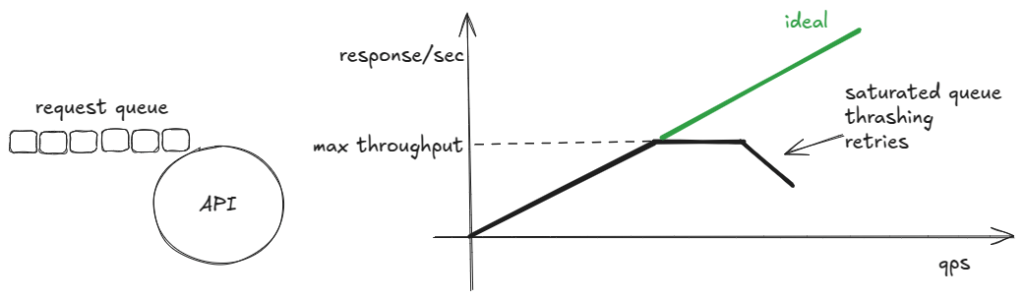
A system is scalable if by adding more resources to it, we can move the max throughput level higher.
We can scale up or scale out, the later is preferable.
Metrics
Size scalability


Administrative scalability
. Beyond resource threshold (say 1000 CPUs), the system’s performance degrades. If our estimate of Resource Threshold is correct, it is an indirect ratio between active tenant count and max supportable tenant count. Here is how. Say, the system can support
active tenants at the max. Then,
. So,
.
Geographic scalability
. We can measure
.
 unreasonably effective
Leave a comment