Brute Force
We need to find the best 

Since all numbers in arr are positive integers, the domain of 
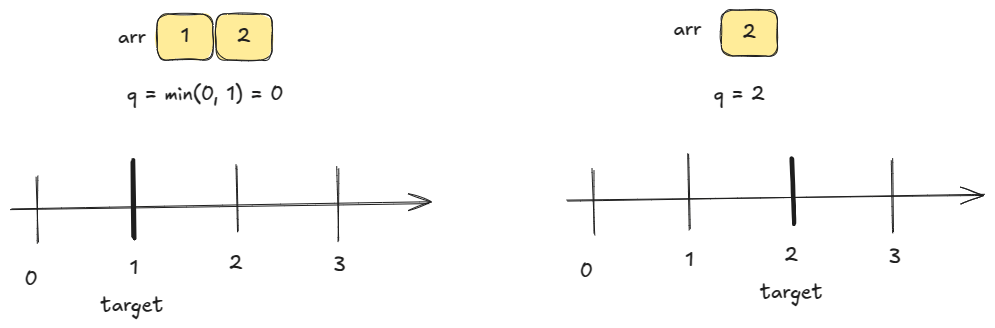
Time: 

class Solution:
    def findBestValue(self, arr: List[int], target: int) -> int:
        min_diff, best_q = float('inf'), float('inf')
        for q in range(target+1):
            capped_sum = sum( min(q, x) for x in arr )

            diff = abs( target - capped_sum )
            if diff > min_diff:
                continue

            best_q = min(best_q, q) if diff == min_diff else q
            min_diff = diff

        return best_q
Sort and search
We can break the inner sum to get rid of 

arr, these two cases are mixed. We can sort arr to separate them out. Then with binary-search, we can find these two regions and with a pre-computed cumsum, the inner loop takes 
Time: 

class Solution:
    def find_insert_index(self, x, nums) -> int:
        lo, hi = 0, len(nums)-1
        while lo <= hi:
            mid = (lo + hi) // 2
            if nums[mid] < x:
                lo = mid+1
            else:
                hi = mid-1
        return lo

    def find_capped_sum(self, q, arr, cumsum) -> int:
        n = len(arr)
        q_pos = self.find_insert_index(q, arr)
        left_sum = cumsum[q_pos-1] if q_pos > 0 else 0
        right_sum = (n - q_pos)*q

        return left_sum + right_sum

    def find_cumsum(self, nums) -> List[int]:
        cumsum = [nums[0]] + [0] * (len(nums)-1)
        for i, x in enumerate(nums[1:], start=1):
            cumsum[i] = cumsum[i-1] + x
        return cumsum

    def findBestValue(self, arr: List[int], target: int) -> int:
        arr.sort()
        cumsum = self.find_cumsum(arr)
        min_diff, best_q = float('inf'), float('inf')
        for q in range(target+1):
            capped_sum = self.find_capped_sum(q, arr, cumsum)

            diff = abs( target - capped_sum )
            if diff > min_diff:
                continue

            best_q = min(best_q, q) if diff == min_diff else q
            min_diff = diff

        return best_q
Given a target and arr of length 

arr has all numbers at least as big as 
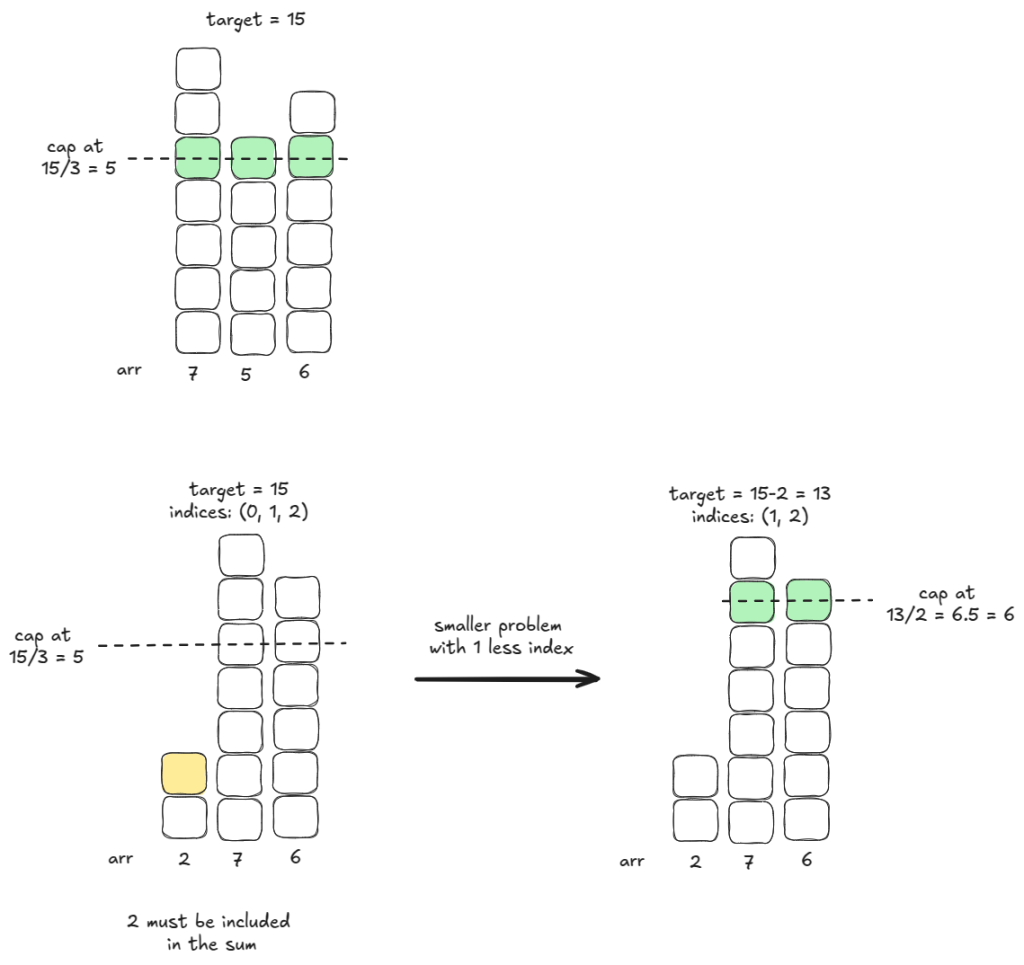
If a number in arr is smaller than arr. If arr was sorted, as soon as we find an allowed perfect size for the suffix arr[j:n+1], we can return the closest number to the perfect size ![\frac{ \texttt{target} - \sum_{i=0}^{j} \texttt{arr}[i] }{ n-j }](https://s0.wp.com/latex.php?latex=%5Cfrac%7B+%5Ctexttt%7Btarget%7D+-+%5Csum_%7Bi%3D0%7D%5E%7Bj%7D+%5Ctexttt%7Barr%7D%5Bi%5D+%7D%7B+n-j+%7D&bg=ffffff&fg=000&s=0&c=20201002)
Time: 
class Solution:
    def find_best(self, begin, arr, target) -> int:
        if begin == len(arr):
            return arr[-1]

        x = arr[begin]
        n = len(arr) - begin
        if n*x < target:
            return self.find_best(begin+1, arr, target-x)

        x_fit = ceil( target/n - 0.5 )
        return x_fit


    def findBestValue(self, arr: List[int], target: int) -> int:
        arr.sort()
        return self.find_best(0, arr, target)
We can do it iteratively to save space.
Time:
class Solution:
    def findBestValue(self, arr: List[int], target: int) -> int:
        arr.sort()
        n = len(arr)
        for i, x in enumerate(arr):
            ncopies = n-i
            if ncopies * x < target:
                # If x is too small, must include
                target -= x
                continue
            return ceil(target/ncopies - 0.5)
        return arr[-1]
 unreasonably effective
Leave a comment