Rotation of the matrix is composed of smaller, independent rotations each of which takes constant extra space.
The matrix can be thought of as a collection of concentric disks. Within each disk there are 4-element loops. We can rotate each loop with just one extra variable.
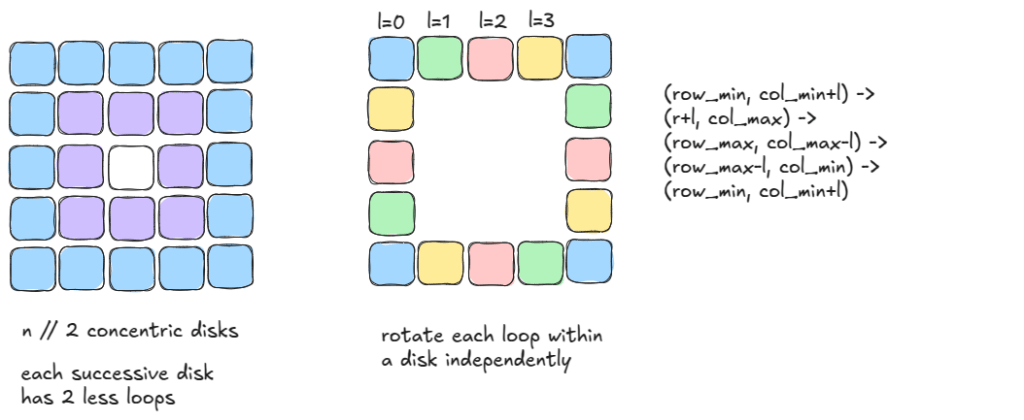
The four transitions within a loop involve: row_min, row_max, col_min, col_max, and loop index. We can deduce all of these from the disk index and 
Time: 

class Solution:
    def rotate(self, matrix: List[List[int]]) -> None:
        """
        Do not return anything, modify matrix in-place instead.
        """
        n = len(matrix)
        disk_count = n // 2
        for d in range(disk_count):
            row_min, col_min = d, d
            row_max, col_max = n-1-d, n-1-d
            loop_count = n-1-2*d
            for l in range(loop_count):
                tmp = matrix[row_min+l][col_max]
                matrix[row_min+l][col_max] = matrix[row_min][col_min+l]

                tmp, matrix[row_max][col_max-l] = matrix[row_max][col_max-l], tmp
                tmp, matrix[row_max-l][col_min] = matrix[row_max-l][col_min], tmp

                matrix[row_min][col_min+l] = tmp
 unreasonably effective
Leave a comment