Per row binary search
Since rows are sorted, for each row we find the would-be insert index of 
Time: 

class Solution:
    def find_insert_index(self, x, nums) -> int:
        # [    >=   |   <   ]
        # ----------|lo------
        lo, hi = 0, len(nums)-1
        while lo <= hi:
            mid = (lo+hi) // 2
            if nums[mid] < x:
                hi = mid-1
            else:
                lo = mid+1
        return lo

    def count_negatives_in_row(self, row) -> int:
        first_negative_index = self.find_insert_index(0, row)
        return len(row) - first_negative_index

    def countNegatives(self, grid: List[List[int]]) -> int:
        count = 0
        for row in grid:
            count += self.count_negatives_in_row(row)
        return count
Trace negative boundary
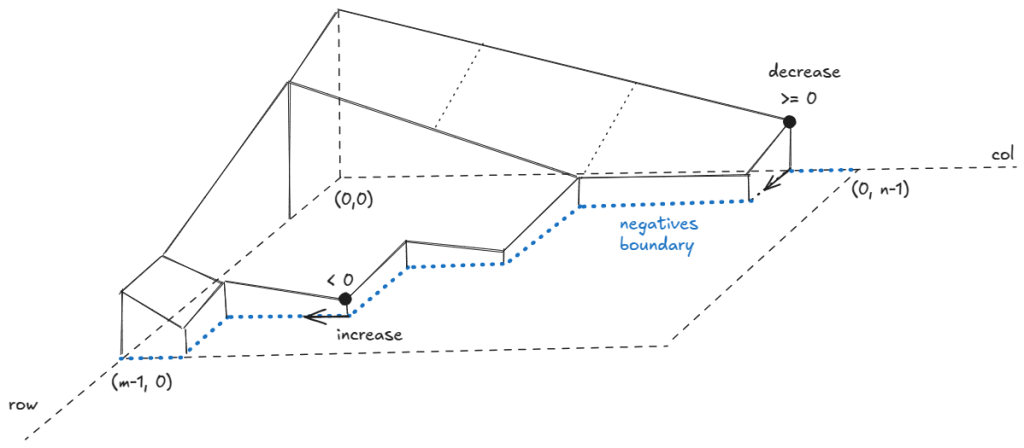
Since the grid is sorted both row-wise and column-wise, at each coordinate we have two directions with “opposite” gradients: one decreasing and one increasing. Using this, starting either from (0, n-1) or (m-1, 0), we can trace the negative boundary and count. If current cell is >= 0, we can follow the decreasing direction. If the cell is < 0, we can follow the increasing direction.
Time: 
class Solution:
    def countNegatives(self, grid: List[List[int]]) -> int:
        m, n = len(grid), len(grid[0])
        r, c = 0, n-1
        count = 0
        while r < m and c >= 0:
            if grid[r][c] >= 0:
                r += 1
                continue
            count += (m-r)
            c -= 1
        return count
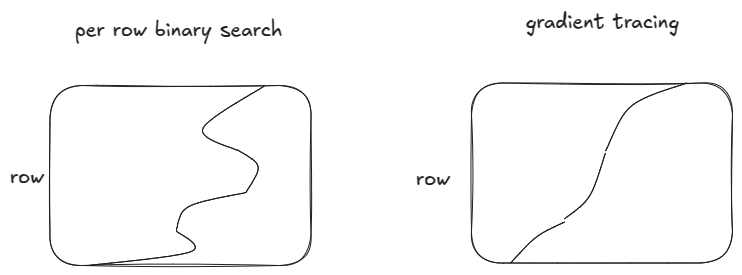
Per row binary search is more generic. Gradient based tracing works when the boundary is monotonic.
 unreasonably effective
Leave a comment