We simulate continuous spiral motion defined by directions and their boundaries. To get the matrix filled up, we piggyback on this motion by hopping in and hopping out at the right times.
We hop in at 
Up -> Right, with Up’s boundary changed from row_min = 0 to row_min = 1. We hop out when we have copied all elements.
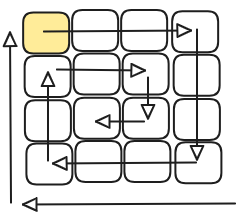
Time: 

from enum import Enum

class Dir(Enum):
    Right = (0, 1)
    Down = (1, 0)
    Left = (0, -1)
    Up = (-1, 0)


class Solution:
    def is_invalid_move(
        self, r, c, curr_dir, row_min, row_max, col_min, col_max
    ) -> bool:
        match curr_dir:
            case Dir.Right:
                return c > col_max
            case Dir.Down:
                return r > row_max
            case Dir.Left:
                return c < col_min
            case Dir.Up:
                return r < row_min

    def updated_boundaries(
        self, curr_dir, row_min, row_max, col_min, col_max
    ) -> Tuple[int]:
        match curr_dir:
            case Dir.Right:
                return (row_min, row_max, col_min, col_max - 1)
            case Dir.Down:
                return (row_min, row_max - 1, col_min, col_max)
            case Dir.Left:
                return (row_min, row_max, col_min + 1, col_max)
            case Dir.Up:
                return (row_min + 1, row_max, col_min, col_max)

    def generateMatrix(self, n: int) -> List[List[int]]:
        last_num = n * n

        mat = [[0] * n for _ in range(n)]

        next_dir = {
            Dir.Right: Dir.Down,
            Dir.Down: Dir.Left,
            Dir.Left: Dir.Up,
            Dir.Up: Dir.Right,
        }
        row_min, row_max = 0, n - 1
        col_min, col_max = 0, n - 1

        # Simulate continuous spiral motion
        # Terminate based on external signal: count of elements
        # Start with valid:
        #  - direction: Up -> Right
        #  - Up's boundary: row_min = 1
        #  - cell: (0, 0)
        #  - x: 1
        r, c, curr_dir = 0, 0, Dir.Right
        row_min += 1
        x = 1
        while x <= last_num:
            mat[r][c] = x
            x += 1

            dr, dc = curr_dir.value
            next_r, next_c = r + dr, c + dc

            if self.is_invalid_move(
                next_r, next_c, curr_dir, row_min, row_max, col_min, col_max
            ):
                row_min, row_max, col_min, col_max = self.updated_boundaries(
                    curr_dir, row_min, row_max, col_min, col_max
                )

                curr_dir = next_dir[curr_dir]

                dr, dc = curr_dir.value
                next_r, next_c = r + dr, c + dc

            r, c = next_r, next_c

        return mat
Encapsulating spiral motion in a separate class makes the piggybacking explicit.
from enum import Enum

class Dir(Enum):
    Right = (0, 1)
    Down = (1, 0)
    Left = (0, -1)
    Up = (-1, 0)

class SpiralOrder:

    next_dir = {
        Dir.Right: Dir.Down,
        Dir.Down: Dir.Left,
        Dir.Left: Dir.Up,
        Dir.Up: Dir.Right,
    }

    def __init__(self, n) -> None:
        self.row_min, self.row_max = 0, n-1
        self.col_min, self.col_max = 0, n-1
        self.r, self.c = 0, -1
        self.curr_dir = Dir.Up

    def is_invalid_move(
        self, dr, dc
    ) -> bool:
        match self.curr_dir:
            case Dir.Right:
                return self.c+dc > self.col_max
            case Dir.Down:
                return self.r+dr > self.row_max
            case Dir.Left:
                return self.c+dc < self.col_min
            case Dir.Up:
                return self.r+dr < self.row_min

    def update_boundaries(
        self, curr_dir
    ) -> None:
        match self.curr_dir:
            case Dir.Right:
                self.col_max -= 1
            case Dir.Down:
                self.row_max -= 1
            case Dir.Left:
                self.col_min += 1
            case Dir.Up:
                self.row_min += 1

    def change_direction(self) -> None:
        self.update_boundaries(self.curr_dir)
        self.curr_dir = self.next_dir[self.curr_dir]

    def __iter__(self):
        return self

    def __next__(self) -> Tuple[int]:
        # No new cell to move to
        if self.row_min > self.row_max or self.col_min > self.col_max:
            return self.r, self.c

        dr, dc = self.curr_dir.value

        if self.is_invalid_move(dr, dc):
            self.change_direction()
            dr, dc = self.curr_dir.value

        self.r, self.c = self.r + dr, self.c + dc
        return self.r, self.c

class Solution:

    def generateMatrix(self, n: int) -> List[List[int]]:
        mat = [[0] * n for _ in range(n)]

        x = 1
        last_num = n * n
        for r, c in SpiralOrder(n):
            if x > last_num:
                break

            mat[r][c] = x
            x += 1
        return mat
 unreasonably effective
Leave a comment