Brute force
For each day we can scan into the future and pick the first day with a higher temperature. Time: 
Stack
If the temperatures are sorted in non-increasing order, no days will have a warmer day in the future. So, if any day has a future warmer day, there must be two consecutive days where temperature increases. Say, 


In this smaller problem, the leftmost increasing pair is either 
![[(i+1) \ldots (n-1)]](https://s0.wp.com/latex.php?latex=%5B%28i%2B1%29+%5Cldots+%28n-1%29%5D&bg=ffffff&fg=000&s=0&c=20201002)


Nesting
Another way to think is, say for the 
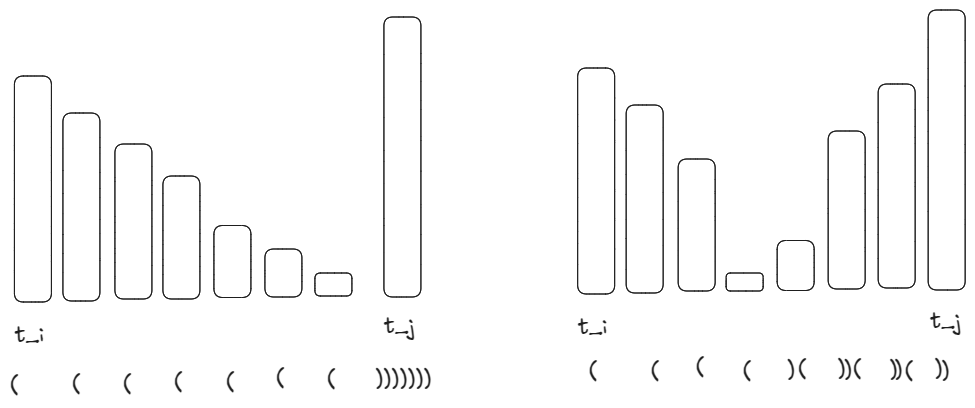
Time: 

class Solution:
    def dailyTemperatures(self, temperatures: List[int]) -> List[int]:
        n = len(temperatures)
        waits = [0] * n
        stack = []
        for i, curr_temp in enumerate(temperatures):
            while stack and curr_temp > temperatures[top := stack[-1]]:
                waits[top] = i - top
                stack.pop()
            stack.append(i)

        return waits
 unreasonably effective
Leave a comment