Special type of directed graph where a node can have at most two outgoing edges and one incoming edge. Unlike graphs, with a binary tree, we differentiate between the two outgoing edges by marking one as left and the other as right.
Test helpers
class TreeNode:
    def __init__(self, val, left=None, right=None):
        self.val = val
        self.left = left
        self.right = right

def serialize(root) -> str:
    if not root:
        return ""
    if not root.left and not root.right:
        return root.val
    left_child = serialize(root.left)
    right_child = serialize(root.right)
    return f"{root.val}({left_child})[{right_child}]"

def deserialize(data) -> TreeNode:
    if not data:
        return None
    l = data.find("(")
    if l < 0:
        return TreeNode(int(data))
    stack = []
    val, sign = None, 1
    for c in data:
        if c.isdigit():
            val = int(c) if val is None else 10*val + int(c)
        elif c == "-":
            sign = -1
        elif c == "(":
            if val is not None:
                val = sign * val
            stack.append(TreeNode(val))
            val, sign = None, 1
            stack.append(c)
        elif c == "[":
            stack.append(c)
        else:
            if val is not None:
                val = sign * val
                stack.append(TreeNode(val))
            val, sign = None, 1

            if stack[-1] == "(" or stack[-1] == "[":
                stack.pop()
                stack.append(None)
            elif stack[-2] == "(" or stack[-2] == "[":
                root = stack.pop()
                stack.pop()
                stack.append(root)
            else:
                right_child = stack.pop()
                left_child = stack.pop()
                root = stack.pop()
                stack.pop()
                root.left = left_child
                root.right = right_child
                stack.append(root)

    right_child = stack.pop()
    left_child = stack.pop()
    root = stack.pop()
    root.left = left_child
    root.right = right_child
    return root
Height
Height of a node 

Height is the count of edges along the longest path from root to a leaf.
def height(root) -> int:
    def is_leaf(u):
        return not (u.left or u.right)
    if not root or is_leaf(root):
        return 0
    return max( height(root.left), height(root.right) ) + 1
def height_stack(root) -> int:
    def is_leaf(u):
        return not (u.left or u.right)
    if not root or is_leaf(root):
        return 0
    height = 0
    stack = [(root, 0)]
    while stack:
        u, h = stack.pop()
        height = max(height, h)
        stack.extend((c, h+1) for c in (u.left, u.right) if c)
    return height
Using “Threaded Binary Tree”, we can traverse a tree using constant extra space. This is called Morris traversal.
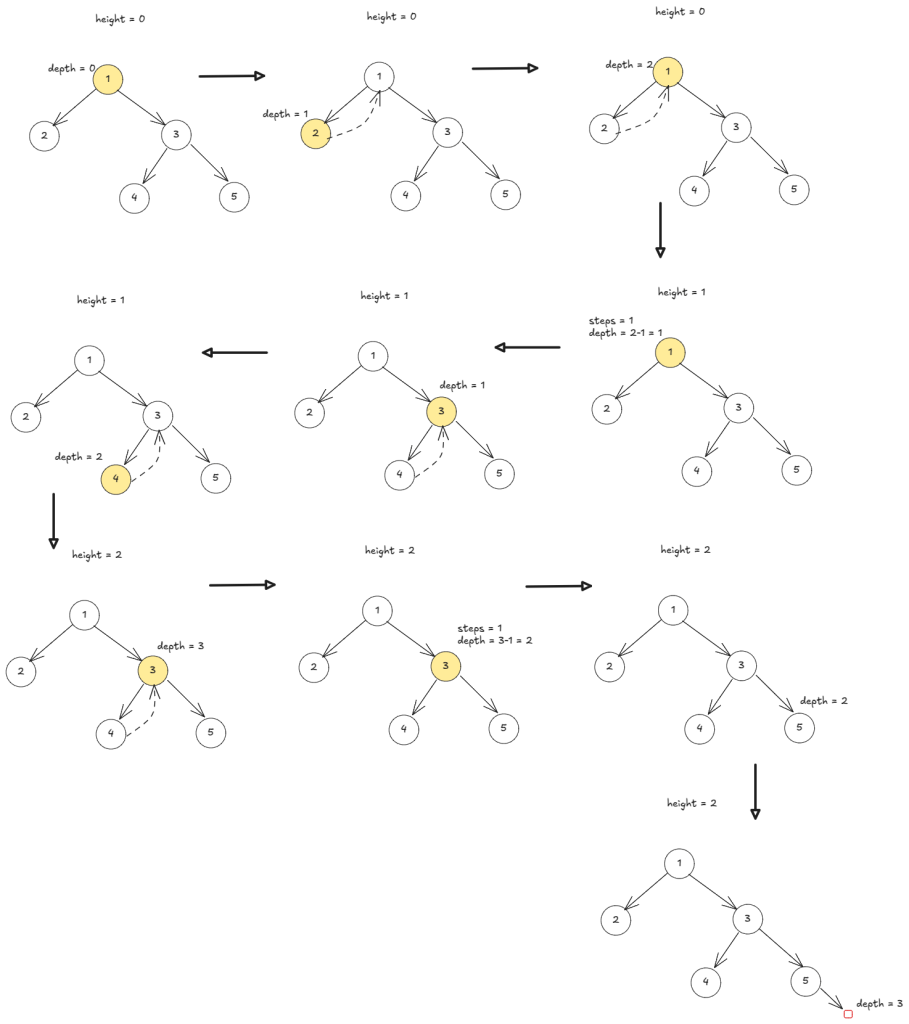
def height_morris(root) -> int:
    depth, height = 0, 0
    while root:
        if not root.left:
            root = root.right
            depth += 1
            height = max(height, depth-1)
            continue
        pred = root.left
        steps = 1
        while pred.right and pred.right != root:
            pred = pred.right
            steps += 1
        if not pred.right:
            pred.right = root
            root = root.left
            depth += 1
            height = max(height, depth-1)
        else:
            pred.right = None
            depth -= steps
            root = root.right
    return height
data = "1(2)[3(4)[5]]"
root = deserialize(data)
h, hs, hm = height(root), height_stack(root), height_morris(root)
print(f"{h=},{hs=},{hm=}")
data = "1()[2()[3]]"
root = deserialize(data)
h, hs, hm = height(root), height_stack(root), height_morris(root)
print(f"{h=},{hs=},{hm=}")
data = "1(2(3)[])[]"
root = deserialize(data)
h, hs, hm = height(root), height_stack(root), height_morris(root)
print(f"{h=},{hs=},{hm=}")
# h=2,hs=2,hm=2
# h=2,hs=2,hm=2
# h=2,hs=2,hm=2
 unreasonably effective
Leave a comment