Recursive
In the binary tree, there are two types of path: (1) linear (2) curved. Sum on a linear path may contribute to parent’s sum. Sum on a curved path does not contribute to parent’s sum.
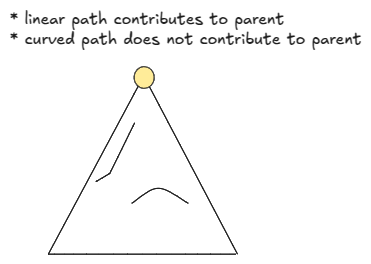
Say 


On the other hand, if 

Then the max path sum of the tree is 
We recursively compute
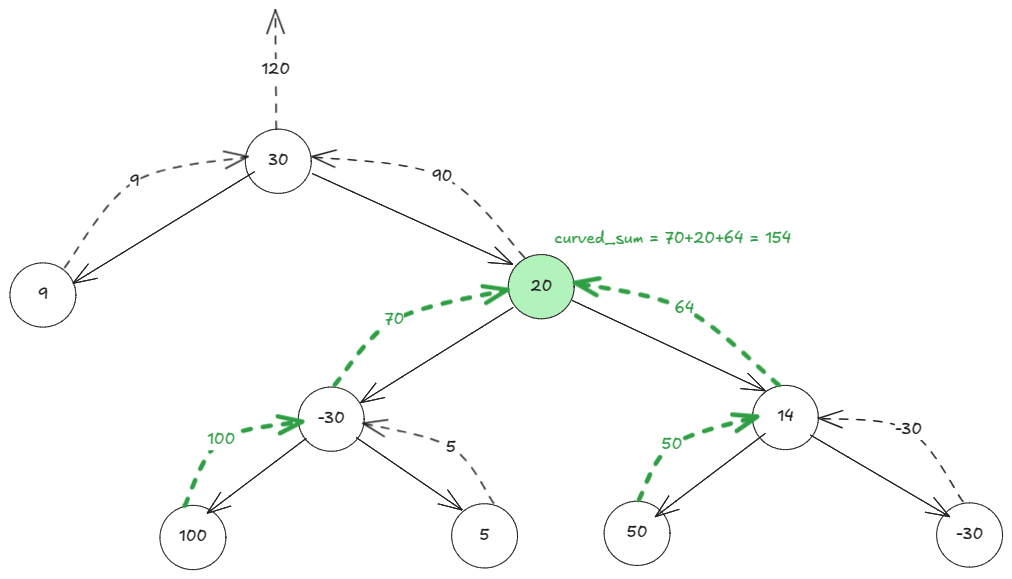
Time: 

# Definition for a binary tree node.
# class TreeNode:
#     def __init__(self, val=0, left=None, right=None):
#         self.val = val
#         self.left = left
#         self.right = right
class Solution:
    def maxPathSum(self, root: Optional[TreeNode]) -> int:
        max_curved_sum = float("-inf")
        max_linear_sum = float("-inf")

        def compute_linear_sum(u) -> int:
            nonlocal max_curved_sum, max_linear_sum
            if not u:
                return 0
            left_linear_sum = compute_linear_sum(u.left)
            right_linear_sum = compute_linear_sum(u.right)
            max_child_linear_sum = max( left_linear_sum, right_linear_sum )

            linear_sum = max( max_child_linear_sum+u.val, u.val )
            max_linear_sum = max( max_linear_sum, linear_sum )

            curved_sum = left_linear_sum + u.val + right_linear_sum
            max_curved_sum = max( max_curved_sum, curved_sum )

            return linear_sum

        _ = compute_linear_sum(root)
        return max(max_curved_sum, max_linear_sum)
Iterative
With explicit stack we simulate the bottom-up recursion using visited set and linear_sums dict. Second time we visit a node, on the return path, the linear sums of its children have already been computed.
# Definition for a binary tree node.
# class TreeNode:
#     def __init__(self, val=0, left=None, right=None):
#         self.val = val
#         self.left = left
#         self.right = right
class Solution:
    def maxPathSum(self, root: Optional[TreeNode]) -> int:
        if not root:
            return 0

        max_curved_sum = float("-inf")
        max_linear_sum = float("-inf")

        visited = set()
        linear_sums = {}
        stack = [root]
        while stack:
            u = stack.pop()

            if u not in visited:
                visited.add(u)
                stack.extend( v for v in (u, u.left, u.right) if v )
                continue

            # Return path: linear sums of u's children are available
            left_linear_sum = linear_sums[u.left] if u.left else 0
            right_linear_sum = linear_sums[u.right] if u.right else 0
            max_child_linear_sum = max( left_linear_sum, right_linear_sum )

            linear_sum = max( u.val, max_child_linear_sum + u.val )
            linear_sums[u] = linear_sum
            max_linear_sum = max( max_linear_sum, linear_sum )

            curved_sum = left_linear_sum + u.val + right_linear_sum
            max_curved_sum = max( max_curved_sum, curved_sum )

        return max( max_curved_sum, max_linear_sum )
 unreasonably effective
Leave a comment