Recursive
We do DFS preferring right. With root 
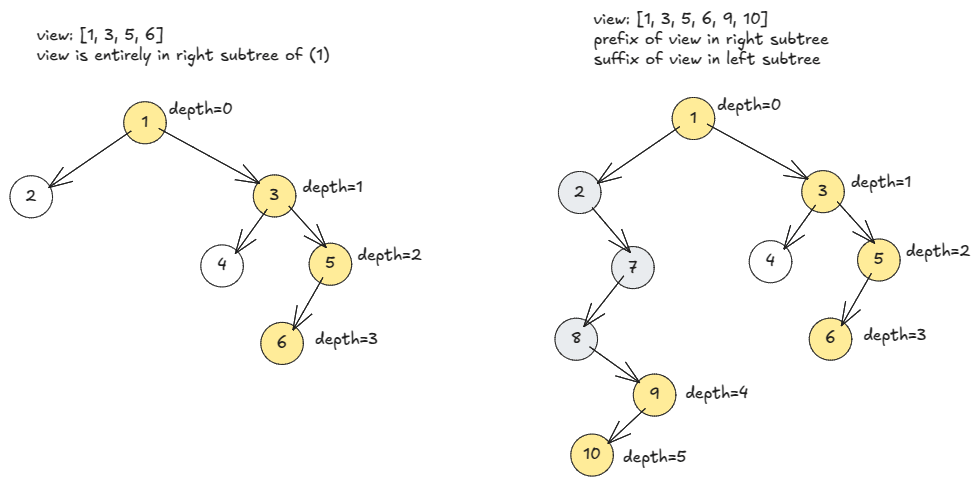
Time: 
# Definition for a binary tree node.
# class TreeNode:
#     def __init__(self, val=0, left=None, right=None):
#         self.val = val
#         self.left = left
#         self.right = right
class Solution:
    def dfs(self, root, view, depth) -> List[int]:
        if not root:
            return

        if depth == len(view):
            view.append(root.val)

        self.dfs(root.right, view, depth+1)
        self.dfs(root.left , view, depth+1)

    def rightSideView(self, root: Optional[TreeNode]) -> List[int]:
        view = []
        self.dfs(root, view, 0)
        return view
Iterative
Simulate top-down depth based recursion with an explicit stack.
Time:
# Definition for a binary tree node.
# class TreeNode:
#     def __init__(self, val=0, left=None, right=None):
#         self.val = val
#         self.left = left
#         self.right = right
class Solution:
    def rightSideView(self, root: Optional[TreeNode]) -> List[int]:
        if not root:
            return []

        view = []
        stack = [(root, 0)]
        while stack:
            u, depth = stack.pop()
            if depth == len(view):
                view.append(u.val)
            stack.extend( (c, depth+1) for c in (u.left, u.right) if c )

        return view
Rightmost node on each level belongs to the right-side view.
Time:
# Definition for a binary tree node.
# class TreeNode:
#     def __init__(self, val=0, left=None, right=None):
#         self.val = val
#         self.left = left
#         self.right = right
class Solution:
    def rightSideView(self, root: Optional[TreeNode]) -> List[int]:
        if not root:
            return []

        view = []
        q = deque([root])
        while q:
            view.append(q[-1].val)
            level_len = len(q)
            for _ in range(level_len):
                u = q.popleft()
                q.extend(c for c in (u.left, u.right) if c)

        return view
 unreasonably effective
Leave a comment