Recursive
We can simulate deleting of the subtree by considering root.val == q as if it were root.val == None.
Time: 

# Definition for a binary tree node.
# class TreeNode:
#     def __init__(self, val=0, left=None, right=None):
#         self.val = val
#         self.left = left
#         self.right = right
class Solution:
    def height_without_q(self, root, q) -> int:
        if not root or root.val == q:
            return -1

        return (
            max(
                self.height_without_q(root.left, q),
                self.height_without_q(root.right, q),
            )
            + 1
        )

    def treeQueries(self, root: Optional[TreeNode], queries: List[int]) -> List[int]:
        return [self.height_without_q(root, q) for q in queries]
Deleting a rooted subtree may or may not affect the longest simple path.
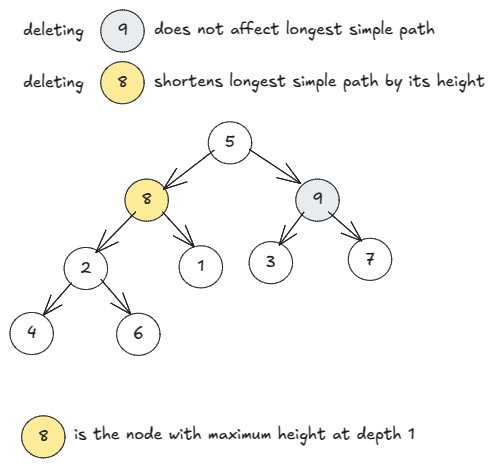
From the level-wise view of the tree we make the below observations:
- The longest simple path goes through one node at each depth.
- The node at a depth that the path goes through has the the greatest height at that depth.
Given a to-be-deleted node 
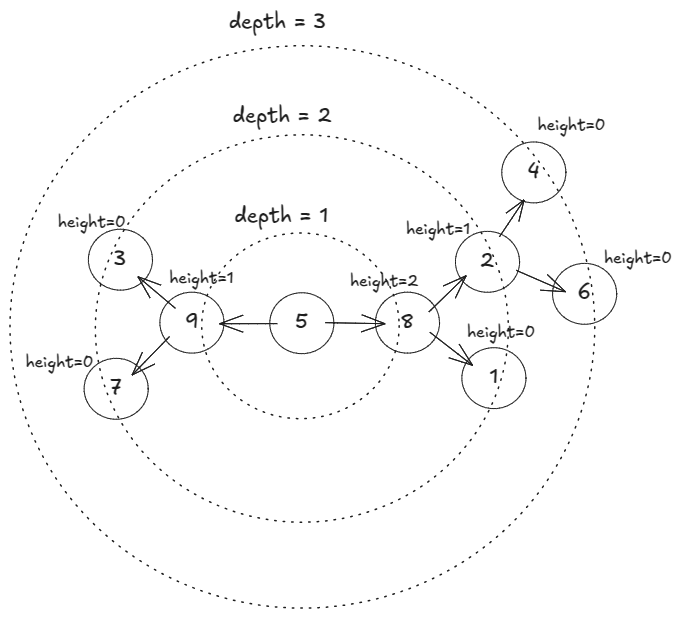
Say, we want to delete the subtree rooted at the node 

- The path stops at the depth
.
- The path stops at the depth
- The path goes through the node with the second greatest height at depth
- The path goes through the node with the second greatest height at depth
If we know three pieces of information: (1) each node’s depth, (2) each node’s height, and (3) at each depth the two nodes with max and second max height, then we can efficiently find what the length of the longest path would be if we deleted a rooted subtree. These information can be collected with a single DFS.
Time: 

# Definition for a binary tree node.
# class TreeNode:
#     def __init__(self, val=0, left=None, right=None):
#         self.val = val
#         self.left = left
#         self.right = right
class Solution:
    def dfs(self, root, depth, coord, level_max) -> int:
        if not root:
            return -1

        left_height = self.dfs(root.left, depth+1, coord, level_max)
        right_height = self.dfs(root.right, depth+1, coord, level_max)
        height = max(left_height, right_height)+1
        coord[root.val] = (depth, height)

        # Keep nodes with max and second max height per depth
        level_max[depth] = level_max.get(depth, []) + [root.val]
        if len(level_max[depth]) > 1:
            level_max[depth].sort(key=lambda x: coord[x][1])
        if len(level_max[depth]) > 2:
            level_max[depth] = level_max[depth][-2:]

        return height

    def treeQueries(self, root: Optional[TreeNode], queries: List[int]) -> List[int]:
        coord, level_max = {}, {}
        self.dfs(root, 0, coord, level_max)
        ans = [-1] * len(queries)
        for i, q in enumerate(queries):
            q_depth, q_height = coord[q]
            if len(level_max[q_depth]) == 1:
                ans[i] = max(0, q_depth-1)
            else:
                ans[i] = q_depth
                second_max, first_max = level_max[q_depth]
                ans[i] += (coord[second_max][1]) if q == first_max else (coord[first_max][1])
        return ans
 unreasonably effective
Leave a comment