Recursive
Each node has three coordinates: row, col, val. The problem is to sort the node-values by its coordinates: column id, row id and value.
We emit column values in sorted order: start with lowest column id and go towards highest. Tracking column id is easy: if 
col, its left child has (col-1) and its right child has (col+1). Within a column, the values would be sorted by row id (or depth). However, if more than one values have same (row_id, column_id) we need to break the tie by value.
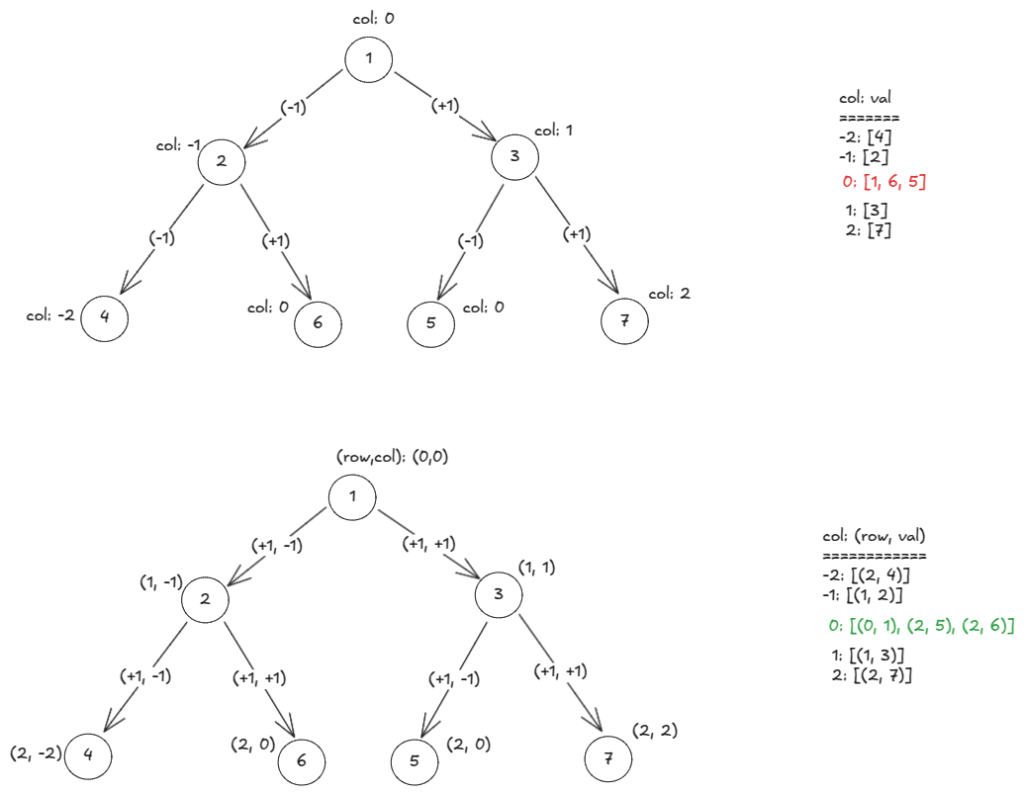
With a single DFS, we can collect the pairs (row_id, val) per column. We then emit columns in sorted order and within a column, we emit the pairs (just val) in sorted order. In that way, within a column, sorting’s primary key is row_id and secondary key is val.
Time: 

# Definition for a binary tree node.
# class TreeNode:
#     def __init__(self, val=0, left=None, right=None):
#         self.val = val
#         self.left = left
#         self.right = right
class Solution:
    def dfs(self, u, row, col, col_values) -> None:
        if not u:
            return
        col_values[col] = col_values.get(col, []) + [(row, u.val)]
        self.dfs(u.left, row+1, col-1, col_values)
        self.dfs(u.right, row+1, col+1, col_values)

    def verticalTraversal(self, root: Optional[TreeNode]) -> List[List[int]]:
        col_values = {}
        self.dfs(root, 0, 0, col_values)
        vertical = []
        for col in sorted(col_values):
            vertical.append( [ val for row, val in sorted(col_values[col]) ] )
        return vertical
Iterative
To collect column’s (row, val) pairs we could also use BFS.
# Definition for a binary tree node.
# class TreeNode:
#     def __init__(self, val=0, left=None, right=None):
#         self.val = val
#         self.left = left
#         self.right = right
class Solution:
    def verticalTraversal(self, root: Optional[TreeNode]) -> List[List[int]]:
        if not root:
            return []

        col_values = {}
        row = 0
        # [ (node, col) ]
        q = deque([(root, 0)])
        while q:
            level_len = len(q)
            for _ in range(level_len):
                u, col = q.popleft()
                col_values[col] = col_values.get(col, []) + [(row, u.val)]
                if u.left:
                    q.append( (u.left, col-1) )
                if u.right:
                    q.append( (u.right, col+1) )

            row += 1

        vertical = []
        for col in sorted(col_values):
            vertical.append( [ val for row, val in sorted(col_values[col]) ] )
        return vertical
 unreasonably effective
Leave a comment