Substrings
For each of the 
word_set.
Say 


class Solution:
    def indexPairs(self, text: str, words: List[str]) -> List[List[int]]:
        word_set = set(words)
        text_words = []
        for i in range(len(text)):
            for j in range(i, len(text)):
                if text[i:j+1] in word_set:
                    text_words.append([i, j])

        return text_words
Trie
If a word is in the text, the word is a prefix of a suffix of the text. Since the text has only 
words, we can efficiently find the prefixes of these
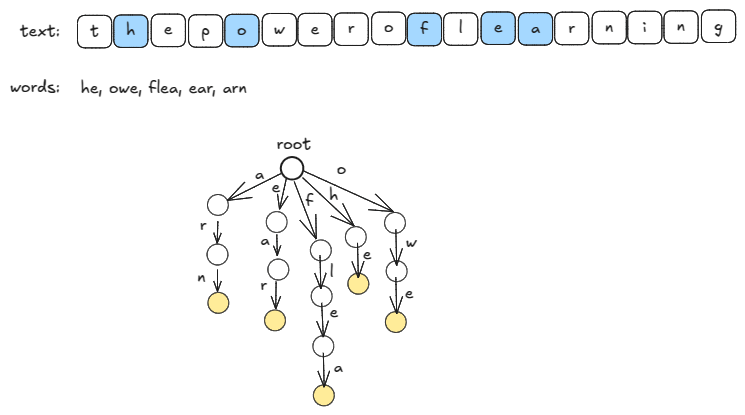
Building the trie takes time prefix_of() takes time 
Time:
class TrieNode:
    def __init__(self):
        self.end_of_word = False
        self.edges = {}

class Trie:
    def __init__(self):
        self.root = TrieNode()

    def insert(self, word):
        u = self.root
        for char in word:
            if char not in u.edges:
                u.edges[char] = TrieNode()
            u = u.edges[char]
        u.end_of_word = True

    def prefix_of(self, word, begin_index):
        prefix_ends = []
        u = self.root
        for i in range(begin_index, len(word)):
            char = word[i]
            if char not in u.edges:
                break
            u = u.edges[char]
            if u.end_of_word:
                prefix_ends.append([begin_index, i])

        return prefix_ends

class Solution:
    def indexPairs(self, text: str, words: List[str]) -> List[List[int]]:
        trie = Trie()
        for w in words:
            trie.insert(w)

        text_words = []
        for suffix_begin in range(len(text)):
            prefixes = trie.prefix_of(text, suffix_begin)
            if not prefixes:
                continue

            text_words.extend(prefixes)

        return text_words
 unreasonably effective
Leave a comment