Since a tie for the maximum frequency must be broken in favor of recent-most value, we should maintain LIFO order per frequency.
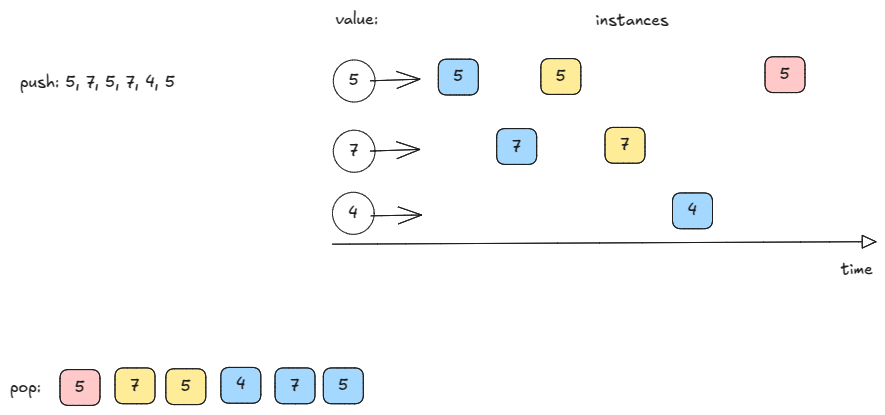
So, we need to maintain a stack per color. We shall use the below three pieces of information:
- A map from frequency to stack of values
- This lets us pop the recent-most value for a given frequency
- A map from value to its frequency
- This lets us push the value to the correct stack from (1)
- A variable
max_frequency- Since the maximum frequency does not jump, it grows like 1, 2, 3, … or decays like 3, 2, 1, we can easily track the current maximum frequency — saving us from searching for the max in the
dictfrom (1).
- Since the maximum frequency does not jump, it grows like 1, 2, 3, … or decays like 3, 2, 1, we can easily track the current maximum frequency — saving us from searching for the max in the
Say there are 
FreqStack having 

| Operation | Time | Space |
__init__ |  | |
push | | |
pop | | |
class FreqStack:

    def __init__(self):
        self.freq_stack = {}
        self.count = {}
        self.max_freq = -1

    def push(self, val: int) -> None:
        self.count[val] = self.count.get(val, 0) + 1

        f = self.count[val]
        if f not in self.freq_stack:
            self.freq_stack[f] = []
        self.freq_stack[f].append(val)

        self.max_freq = max(self.max_freq, f)

    def pop(self) -> int:
        v = self.freq_stack[self.max_freq].pop()

        if not self.freq_stack[self.max_freq]:
            self.max_freq -= 1

        self.count[v] -= 1
        return v


# Your FreqStack object will be instantiated and called as such:
# obj = FreqStack()
# obj.push(val)
# param_2 = obj.pop()
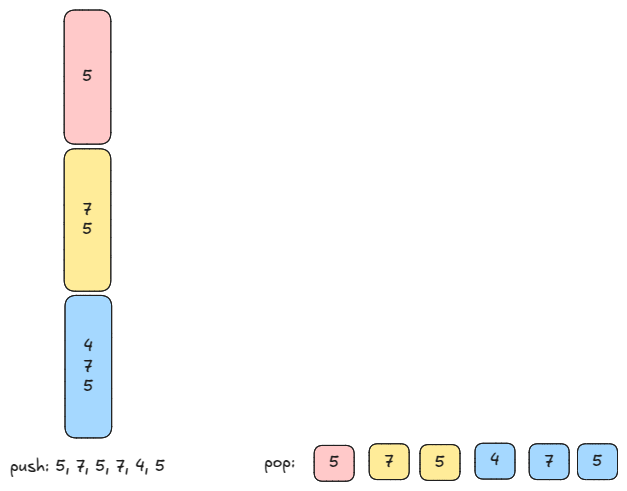
We can also implement FreqStack as a stack of stacks. We push a value onto a frequency-appropriate stack or we push a stack onto the stack of stacks. Similarly, we pop value from the top stack or if top stack is empty we pop it from the stack of stacks.
class FreqStack:

    def __init__(self):
        self.stacks = []
        self.count = {}

    def push(self, val: int) -> None:
        self.count[val] = self.count.get(val, 0) + 1

        f = self.count[val]
        if f > len(self.stacks):
            self.stacks.append([])

        self.stacks[f-1].append(val)

    def pop(self) -> int:
        v = self.stacks[-1].pop()

        if not self.stacks[-1]:
            self.stacks.pop()

        self.count[v] -= 1
        return v


# Your FreqStack object will be instantiated and called as such:
# obj = FreqStack()
# obj.push(val)
# param_2 = obj.pop()
 unreasonably effective
Leave a comment