Say we have an equivalence relation 


As an example, we need to answer this question to build the minimum spanning tree of an weighted, undirected graph like below.
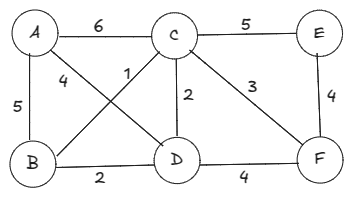
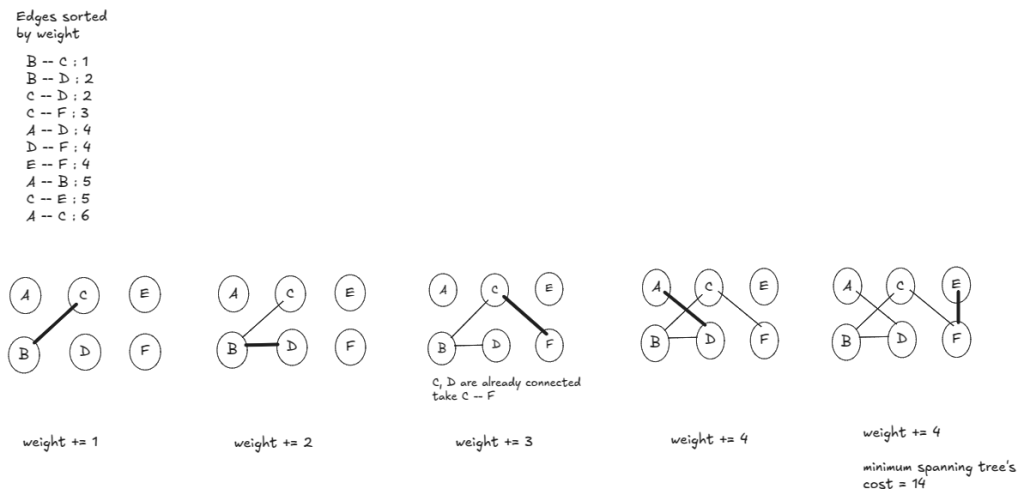
Here, the vertex set 


We start with 

Union-find is a data structure that lets us answer this question efficiently using tree-representation for each equivalence class or partition.
class UnionFind:
    def __init__(self, S):
        self.parent_of = {a: a for a in S}
        self.rank_of = {a: 0 for a in S}

    def find(self, a):
        root = a
        while root != (p := self.parent_of[root]):
            root = p
        return root

    def union(self, a, b):
        root_a = self.find(a)
        root_b = self.find(b)
        if root_a == root_b:
            return

        rank_a = self.rank_of[root_a]
        rank_b = self.rank_of[root_b]
        if rank_a == rank_b:
            self.parent_of[root_a] = root_b
            self.rank_of[root_b] += 1
            return

        if rank_a < rank_b:
            self.parent_of[root_a] = root_b
        else:
            self.parent_of[root_b] = root_a
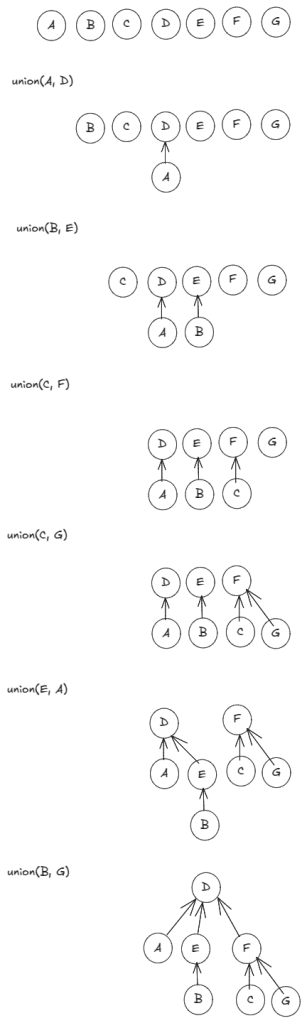
For the minimum spanning tree, for an edge (a, b) if find(a) == find(b), the two vertices a and b are already connected, so we would not include the edge (a, b) in the spanning tree. If, on the other hand, find(a) != find(b), we would include the edge in the spanning tree and by union(a, b) would put a and b in the same connected component.
Note, rank_a is the height of the root of the tree that contains a. And, both find() and union() take time 
If 

Because, a root of rank 


| Operation | Time | Space |
__init__ |  | |
find |  |  |
union | | |
Path compression
During find(), we can compress the path from the node a to its root — making subsequent find()‘s faster.
class UnionFindPC:
    def __init__(self, S):
        self.parent_of = {a: a for a in S}
        self.rank_of = {a: 0 for a in S}

    def __compress_path(self, a, root):
        while a != (p := self.parent_of[a]):
            self.parent_of[a] = root
            a = p

    def find(self, a):
        root = a
        while root != self.parent_of[root]:
            root = self.parent_of[root]
        self.__compress_path(a, root)
        return root

    def union(self, a, b):
        root_a = self.find(a)
        root_b = self.find(b)
        if root_a == root_b:
            return

        rank_a = self.rank_of[root_a]
        rank_b = self.rank_of[root_b]
        if rank_a == rank_b:
            self.parent_of[root_a] = root_b
            self.rank_of[root_b] += 1
            return

        if rank_a < rank_b:
            self.parent_of[root_a] = root_b
        else:
            self.parent_of[root_b] = root_a
 unreasonably effective
Leave a comment