Dynamic programming
For a one-cell (i, j) we can reach the nearest zero-cell via one of its four neighbors. So, if the four neighbors of the cell have already been solved, we can solve (i, j). This suggests DP.
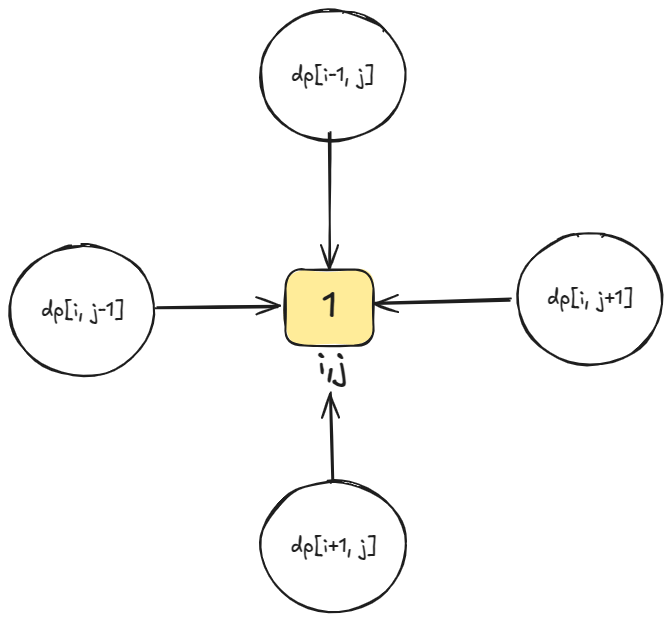
Sub-problem
![dp[i][j] = \begin{cases} 0, & \text{if } mat[i][j] = 0 \\ 1 + \min \left( \left\{ dp[i-1][j], dp[i, j+1], dp[i+1][j], dp[i][j-1] \right\} \right), & \text{otherwise} \end{cases}](https://s0.wp.com/latex.php?latex=dp%5Bi%5D%5Bj%5D+%3D+%5Cbegin%7Bcases%7D+0%2C+%26+%5Ctext%7Bif+%7D+mat%5Bi%5D%5Bj%5D+%3D+0+%5C%5C+1+%2B+%5Cmin+%5Cleft%28+%5Cleft%5C%7B+dp%5Bi-1%5D%5Bj%5D%2C+dp%5Bi%2C+j%2B1%5D%2C+dp%5Bi%2B1%5D%5Bj%5D%2C+dp%5Bi%5D%5Bj-1%5D+%5Cright%5C%7D+%5Cright%29%2C+%26+%5Ctext%7Botherwise%7D+%5Cend%7Bcases%7D&bg=ffffff&fg=000&s=0&c=20201002)
Order
The directed graph has cycles between neighbors.
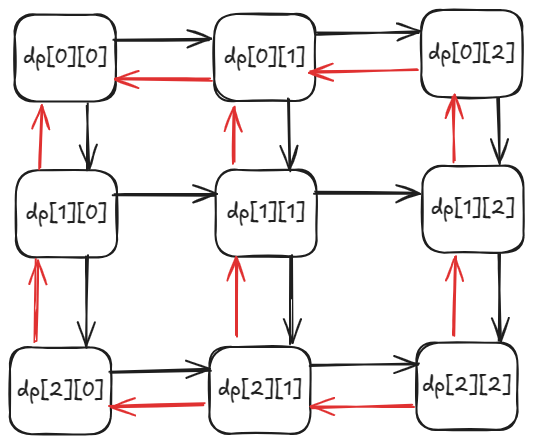
We can process black arrows in one-pass (top-to-bottom, south-east-wards) and red arrows in a second pass (bottom-to-top, north-west-wards). In that way, each pass would have its DAG and would allow topological order.
Time: 
class Solution:
    def updateMatrix(self, mat: List[List[int]]) -> List[List[int]]:
        m, n = len(mat), len(mat[0])
        dp = [
            [float('inf')] * n for _ in range(m)
        ]
        # Top to bottom
        # South-east wards
        for r in range(m):
            for c in range(n):
                if mat[r][c] == 0:
                    dp[r][c] = 0
                    continue
                up =   dp[r-1][c  ] if r > 0 else float('inf')
                left = dp[r  ][c-1] if c > 0 else float('inf')
                dp[r][c] = min( dp[r][c], 1+up, 1+left )

        # Bottom to top
        # North-west wards
        for r in range(m-1, -1, -1):
            for c in range(n-1, -1, -1):
                if mat[r][c] == 0:
                    continue
                down =  dp[r+1][c  ] if r < m-1 else float('inf')
                right = dp[r  ][c+1] if c < n-1 else float('inf')
                dp[r][c] = min( dp[r][c], 1+down, 1+right )

        return dp
 unreasonably effective
Leave a comment