We can check if a string is a palindrome in two ways:
- Inwards from the two ends
- Outwards from center
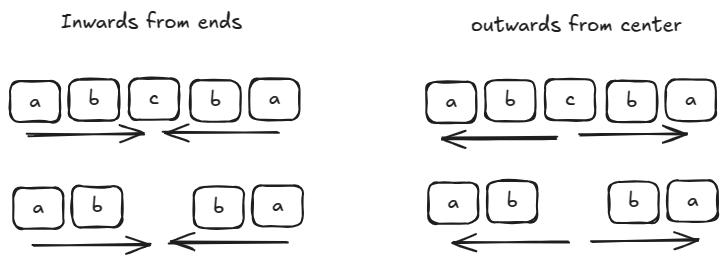
Both ways take 

Process inwards from two ends
Brute force
Try all possible substrings.
Time: 

class Solution:
    def countSubstrings(self, s: str) -> int:
        def is_palindrome(s: str, l: int, r: int) -> bool:
            while l < r:
                if s[l] != s[r]:
                    return False
                l, r = l+1, r-1
            return True

        n = len(s)
        count = 0
        for start in range(n):
            for end in range(start, n):
                count += (1 if is_palindrome(s, start, end) else 0)
        return count
Dynamic programming
Using DP, for all possible substrings, we can compute if it is a palindrome in total 
Subproblem
Let 
s[i:j+1] is a palindrome. Then:
![P(i, j) = \begin{cases} \texttt{true}, & \text{if } i < j \\ P(i+1, j-1), & \text{if } s[i] = s[j] \\ \texttt{false} & \text{otherwise} \end{cases}](https://s0.wp.com/latex.php?latex=P%28i%2C+j%29+%3D+%5Cbegin%7Bcases%7D+%5Ctexttt%7Btrue%7D%2C+%26+%5Ctext%7Bif+%7D+i+%3C+j+%5C%5C+P%28i%2B1%2C+j-1%29%2C+%26+%5Ctext%7Bif+%7D+s%5Bi%5D+%3D+s%5Bj%5D+%5C%5C+%5Ctexttt%7Bfalse%7D+%26+%5Ctext%7Botherwise%7D+%5Cend%7Bcases%7D&bg=ffffff&fg=000&s=0&c=20201002)
Order
Size of a subproblem is 
Time:
class Solution:
    def countSubstrings(self, s: str) -> int:
        n = len(s)
        dp = [[False] * n for _ in range(n)]
        for i in range(n):
            dp[i][i] = True
        count = n

        for sz in range(2, n + 1):
            for i in range(0, n - sz + 1):
                j = i + sz - 1
                dp[i][j] = (s[i] == s[j]) and (dp[i + 1][j - 1] if i + 2 <= j else True)
                count += (1 if dp[i][j] else 0)

        return count
Process outwards from center
Brute force
Time:
class Solution:
    def countSubstrings(self, s: str) -> int:
        def count_palindromes(s: str, left: int, right: int):
            n = len(s)
            count = 0
            while left >= 0 and right < n:
                if s[left] != s[right]:
                    break
                count, left, right = count+1, left-1, right+1
            return count

        n = len(s)
        count = n
        for c in range(n):
            count += count_palindromes(s, c-1, c+1)
            count += count_palindromes(s, c,   c+1)
        return count
 unreasonably effective
Leave a comment